Updated March 2026
In This Guide:
- Why Manual SEO is Dead
- The Top 7 SEO Software Stack
- Step-by-Step Ranking Pipeline
- Real Example: Ranking a Niche Keyword
- FAQ: Google Guidelines & Costs
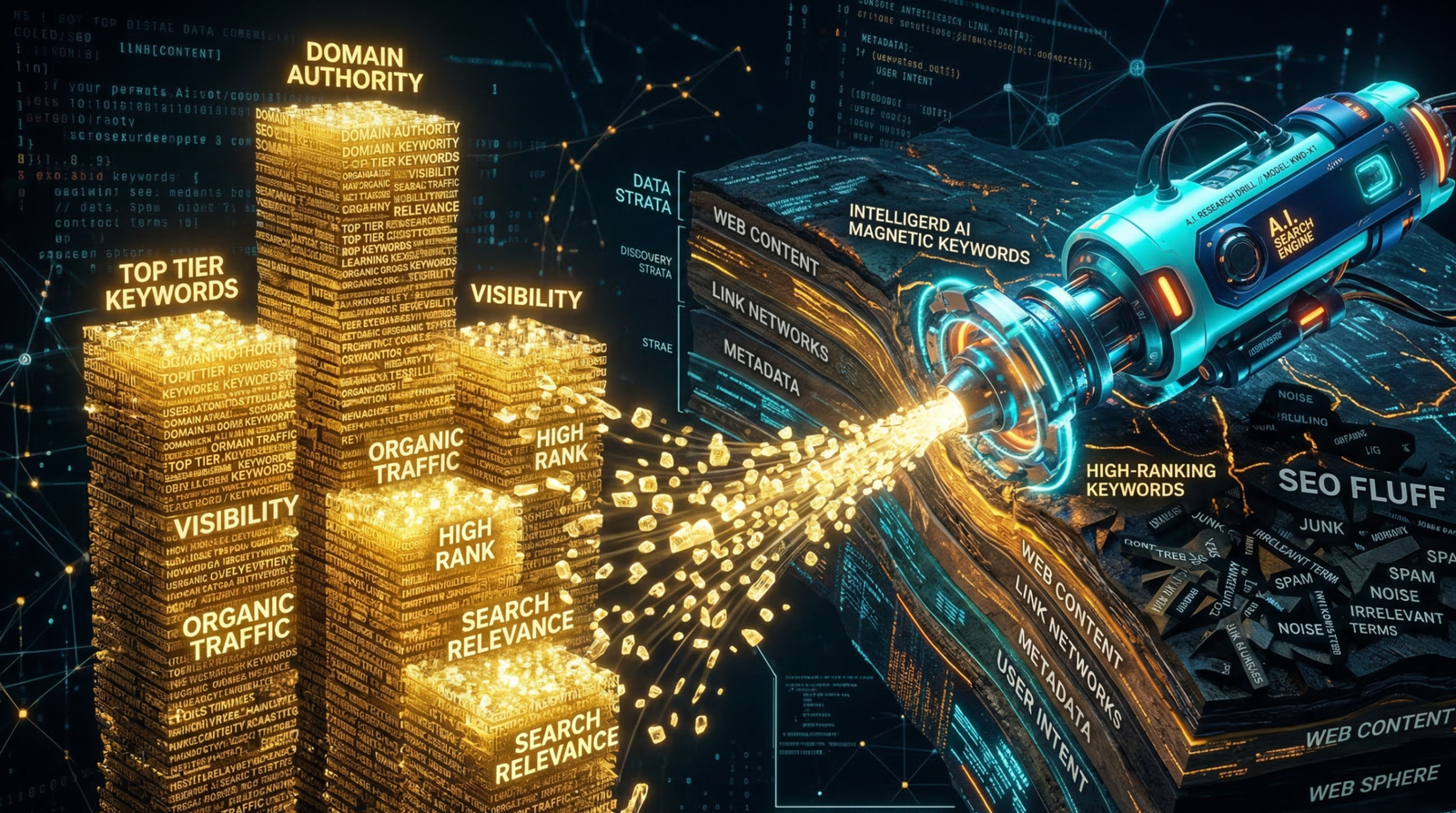
Manually counting keyword density and guessing user intent in 2026 is a strategy built on sand. Google’s algorithm no longer responds to keyword frequency or link volume alone — it evaluates topical authority, semantic entity coverage, and content depth against the live competitive landscape. Every page you publish without data is a page you’re hoping performs rather than engineering to rank.
The shift is from guessing to certainty. The ai seo tools in this guide don’t speculate about what Google wants — they analyze the top 10 ranking pages in real time and tell you exactly what entities, headings, word counts, and supporting topics are required to compete. This is SEO as data-driven science, not creative intuition.
Why AI Search Optimization Matters Today For Organic Traffic
Google’s transition from exact-match keyword scoring to machine-learning-based semantic evaluation changed the entire premise of content marketing. A page that contains the target keyword 20 times but lacks the supporting entities, related concepts, and authoritative depth that Google associates with topical expertise will lose to a competitor that covers the topic comprehensively — even if that competitor’s keyword density is lower.
What modern ai seo tools do is reverse-engineer what “comprehensive” means for any given query. They analyze the top 10 pages currently ranking for a target term and extract the exact pattern: which entities appear consistently across winners, which secondary questions are addressed, what average word count the SERP rewards, and which headers appear in the majority of ranking pages. The output isn’t a suggestion — it’s a blueprint derived from what Google has already decided is authoritative for that topic.
The practical consequence for publishers and agencies: organic traffic is no longer captured by the site with the most backlinks or the highest domain authority alone. It’s captured by the page that most completely satisfies the full scope of a searcher’s query. AI content optimization tools make that scope measurable and achievable — turning what was previously a month of trial-and-error into a single structured content brief before the first word is written.
For niche sites and agencies operating at scale, this also changes the economics of content production. When a brief is mathematically specified before writing begins, content that requires three rounds of revision to hit ranking thresholds collapses to one. SEO analysis at this level isn’t a post-publication audit — it’s a pre-publication specification.
The Ultimate SEO AI Software Stack: SurferSEO vs Ahrefs vs ChatGPT
SurferSEO — The Content Optimization Standard
SurferSEO is the industry benchmark for ai content optimization because it operates on a principle no manual audit can replicate: it analyzes every ranking competitor’s page in real time and generates a mathematically derived content specification for yours. Its Content Editor provides a live score (0–100) that updates as you write, tracking entity inclusion, word count, heading structure, and keyword usage against the competitive average. The target is 80+. Pages consistently hitting that threshold enter ranking positions faster and hold them longer than those below it.
The feature that separates Surfer from simpler content scoring tools is its Topical Map: input a seed topic and it generates a cluster of articles your site needs to establish topical authority — with each article’s brief already mapped to competitive data. For niche publishers building out category authority, this eliminates the guesswork of what to write next and replaces it with a sequenced content roadmap derived from actual SERP data.
For teams using AI-assisted writing alongside Surfer, the native integration with Jasper AI allows draft generation and live scoring within the same interface. For a full walkthrough on accelerating content production, see [How to Use ChatGPT for Blogging in 2026: Write Posts 10x Faster].
| Plan | Price | Key Features |
|---|---|---|
| Essential | $89/month | 30 articles/month, Content Editor, Topical Map |
| Advanced | $179/month | 100 articles/month, team access, AI audit |
| Max | $299/month | Unlimited articles, white-label, API |
✅ Pros: Live scoring with entity-level specificity is unmatched. Topical Map makes content calendar planning data-driven rather than intuitive. ❌ Cons: Price entry point is high for solo publishers. Content Editor value requires users to actually understand and apply the entity recommendations — passive use underdelivers.
Ahrefs AI — The Backlink and Intent Intelligence Engine
Ahrefs is the tool that answers the questions SurferSEO doesn’t ask: where is your competitors’ traffic coming from, which keywords are they ranking for that you aren’t, and what content gaps represent the highest-ROI publishing opportunities right now. Its 2026 AI layer adds two capabilities that change how keyword strategy is built at scale.
The first is AI Keyword Clustering: paste thousands of raw keyword export rows and Ahrefs groups them by semantic intent and topical similarity — collapsing a chaotic keyword research export into a structured content architecture in seconds. What previously required hours of manual grouping becomes a five-minute operation that produces a prioritized cluster map.
The second is Content Gap Analysis at the competitor level: input any competitor domain, and Ahrefs identifies every keyword they rank for in positions 1–10 that your site doesn’t appear for at all. Combined with its keyword difficulty and traffic potential data, this produces a ranked acquisition list ordered by realistic ROI — the highest-traffic, lowest-difficulty opportunities your competitor is currently capturing and you’re not.
| Plan | Price | Key Features |
|---|---|---|
| Lite | $129/month | 5 projects, full keyword + backlink data |
| Standard | $249/month | 20 projects, content gap, AI clustering |
| Advanced | $449/month | 50 projects, API, advanced reports |
✅ Pros: Backlink intelligence and competitor gap analysis are best-in-class. AI clustering converts raw keyword data into a publishable content strategy faster than any competing tool. ❌ Cons: Full value requires Standard plan — Lite tier limits the competitive analysis features most agencies actually need. Not a content editor; pairs with Surfer rather than replacing it.
ChatGPT (Advanced Web Browsing) — The Strategy and Schema Brain
Where SurferSEO and Ahrefs provide data, ChatGPT with Advanced Web Browsing provides interpretation and ideation — the layer of reasoning that turns competitive data into unique editorial angles. Its highest-value seo ai software use cases aren’t content generation (though it does that well) — they’re the strategic decisions that data tools surface but don’t solve.
Feed it a Surfer-generated content brief and prompt: “What unique angles, counterintuitive arguments, or expert perspectives are missing from the current top 10 ranking pages for this query?” ChatGPT reads those pages in real time and identifies the editorial gaps that represent genuine differentiation opportunities — the perspectives none of the current ranking pages take, which means Google has yet to surface them as authoritative.
Its second high-value SEO function is schema markup generation. Provide your article’s structure and target query, and ChatGPT generates valid JSON-LD FAQ, HowTo, or Article schema ready to paste into your page’s header. For publishers who don’t have a developer, this eliminates a technical SEO step that previously required either coding knowledge or a paid plugin.
| Plan | Price | Key Features |
|---|---|---|
| Free | $0 | GPT-4o mini, limited web browsing |
| Plus | $20/month | GPT-4o, full web browsing, advanced analysis |
| Team | $30/user/month | Shared workspace, privacy controls |
✅ Pros: Schema markup generation and editorial angle identification are immediate, practical SEO outputs. Free tier is genuinely usable for planning and brainstorming without a paid subscription. ❌ Cons: Doesn’t replace data-driven tools — complements them. Web browsing accuracy requires prompt specificity; vague requests return generic content.
Three-Way Comparison
| SurferSEO | Ahrefs AI | ChatGPT | |
|---|---|---|---|
| Primary Role | Live content optimization scoring | Competitor and keyword intelligence | Strategy, schema, editorial angles |
| Best For | Writers and content teams | Agencies and SEO strategists | All levels — from beginners to experts |
| Core Feature | Real-time Content Editor (0–100 score) | AI Keyword Clustering + Content Gap | Web Browsing + schema generation |
| Free Tier | ❌ No | ❌ No (7-day trial) | ✅ GPT-4o mini |
| Coding Required | ❌ None | ❌ None | ❌ None |
The Supporting Cast: Tools 4–7
For publishers and agencies building out a full ai seo automation infrastructure beyond the top three:
- MarketMuse — Enterprise-grade topical authority modeling. Builds full content briefs at the site-wide authority level, not just individual page optimization. Best for large sites with 500+ pages managing complex topical coverage gaps.
- Clearscope — The Google Docs-native content optimizer. Scores content for semantic relevance without leaving the document — the lowest-friction integration for editorial teams already working in Docs.
- Jasper AI — Native SurferSEO integration generates AI-drafted content with live optimization scoring active. The highest-efficiency first-draft pipeline for teams running Surfer alongside AI writing.
- Alli AI — The only tool in this list that handles ai seo automation at the technical level. It deploys code fixes for meta tags, structured data, and page speed issues directly to your site without touching the CMS — no developer involvement required.
For connecting these tools into a seamless automated pipeline, see [How to Automate Your Workflow with Zapier AI Agents].
Step-By-Step Guide To AI SEO Automation And Content Pipelines
Practical Workflow: Dominating “Best Email Marketing Software”
This is the exact tool interplay for a high-competition commercial query from research to published, ranking-ready content.
Step 1: Choose the Tool Based on Your Bottleneck
If the problem is not knowing what to write, start with Ahrefs. If the problem is not knowing how to structure what you’re writing, start with Surfer. For the “best email marketing software” target, both are needed: Ahrefs to verify the opportunity and map intent, Surfer to specify the content structure.
Step 2: Set Up Configuration — Ahrefs Site Audit and Content Gap
Run Ahrefs Content Gap: input your domain vs. two to three competitors already ranking for “best email marketing software.” Ahrefs returns every keyword variation they rank for in positions 1–10 that your site doesn’t appear for — including long-tail variants like “best email marketing software for ecommerce,” “best email marketing software for small business,” and “best email marketing software free tier.” This tells you the full semantic scope the article needs to cover to capture the query cluster. For context on the actual tools you’ll need to compare in the article, see [Top AI Tools for Email Marketing Automation in 2026].
Step 3: Connect the Workflow — Generate the SurferSEO Editor Link
Open SurferSEO, enter “best email marketing software” as the target keyword, and generate a Content Editor. Surfer analyzes the current top 10 ranking pages and returns the specification: 2,400 words, 18 H2 headings, 47 required entities (specific tool names, feature categories, pricing terminology), and a target score of 80+. This is your mathematical content brief — every editorial decision from here is measured against this benchmark.
Step 4: Test, Draft, and Hit the Score
Open ChatGPT with web browsing enabled. Prompt: “Review the top 10 ranking pages for ‘best email marketing software.’ What unique angles, expert perspectives, or comparison frameworks do none of them currently address?” ChatGPT identifies the editorial gap — perhaps none of the current ranking pages include a deliverability comparison section or a workflow automation depth comparison. That gap becomes your article’s differentiating editorial angle.
Write or generate the draft. Monitor the Surfer score in real time — prioritize reaching 80+ by ensuring all 47 required entities appear naturally in context. Once the draft hits threshold, use ChatGPT to generate FAQ schema markup:
Generate valid JSON-LD FAQ schema for the following five questions and answers
that appear in my article about best email marketing software: [paste Q&A pairs]
Paste the output into your page’s <head> section for FAQ rich result eligibility.
Step 5: Publish and Monitor
Publish the article. In Ahrefs, set a keyword tracking alert for “best email marketing software” and its top 5 long-tail variants. Configure a weekly rankings email — any movement into the top 20 signals the page is being indexed and evaluated. Any stall in position 25–50 after 60 days signals a content or authority gap to address. Return to Surfer, re-run the Content Editor against the current SERP (which may have changed since drafting), and make the incremental updates the new competitive data recommends.
FAQ About AI SEO Tools And Search Rankings
Which tool is best for a complete beginner?
ChatGPT — free, immediately accessible, and capable of producing keyword research frameworks, content outlines, meta tag drafts, and schema markup without any SEO background. Begin by prompting it to analyze a target query and suggest a content structure. Add Surfer and Ahrefs once you understand the workflow well enough to interpret their data output.
Do these tools require any coding knowledge?
No. SurferSEO, Ahrefs, Clearscope, MarketMuse, and Jasper are entirely no-code platforms — point, click, and act on the recommendations. Alli AI is the only tool in this list that writes and deploys code, but it does so autonomously. ChatGPT generates schema markup that you copy-paste; no ability to write the JSON-LD yourself is required.
How much does a complete AI SEO stack cost?
ChatGPT Plus at $20/month is the minimum entry point for AI-assisted SEO. A professional stack — SurferSEO Essential ($89) + Ahrefs Lite ($129) + ChatGPT Plus ($20) — runs approximately $238/month. Agencies requiring full competitive analysis and content optimization at volume typically operate at $300–$500/month for the complete data infrastructure. Return on that investment is measured in organic traffic and ranking positions, not tool subscriptions — for most niche publishers, a single top-10 ranking on a commercial query generates more monthly revenue than the full stack costs.
Is AI-generated content safe for Google rankings in 2026?
Yes. Google’s Helpful Content guidelines explicitly evaluate content quality and usefulness — not the method of production. AI-generated content that is accurate, comprehensive, and genuinely serves user intent ranks identically to human-written content that meets the same standards. What Google penalizes is spam: mass-produced, low-quality, repetitive content designed to manipulate rankings without providing value. AI-assisted content that follows the Surfer-informed structure, covers the required entities, and addresses the query comprehensively is not spam — it’s a well-specified article that happens to have been drafted efficiently.
Conclusion: From Guessing to Mathematical Certainty
The era of hoping your content ranks based on instinct and keyword count is over. With the right ai seo tools, every content decision — what to write, how to structure it, which entities to include, and how long to make it — becomes a data output rather than a creative guess. Seo analysis at this level transforms content production from an art form into a repeatable, scalable system.
The top 10 is not random in 2026. It’s a pattern. The sites occupying it have satisfied Google’s semantic authority evaluation more completely than their competitors. AI seo tools make that evaluation visible — and replicable — for any publisher willing to use them.
To scale these results across your full business stack, read the complete resource: [The Best AI Tools for Small Business in 2026: The Ultimate Growth Guide →]
Guide last updated: March 2026 by ToolChamber Editoral Team. Pricing and platform features are subject to change — verify current plans on each tool’s official website before subscribing.