Last Updated April 2026
In This Guide:
- Artistic Quality and Photorealism
- Round 1: Artistic Quality and Photorealism
- Round 2: Workflow and User Interface
- Round 3: Pricing and Free Tiers
- The Secret Weapon: Image-to-Video Integration
- The Final Verdict: Which One Should You Choose?
For decades, digital marketers, bloggers, and designers were trapped in the expensive cycle of stock photography. If you wanted a high-quality image of a “businessman looking stressed at a computer,” you had to pay a premium to sites like Getty or Shutterstock. If you wanted custom artwork, you had to hire an illustrator and wait weeks.
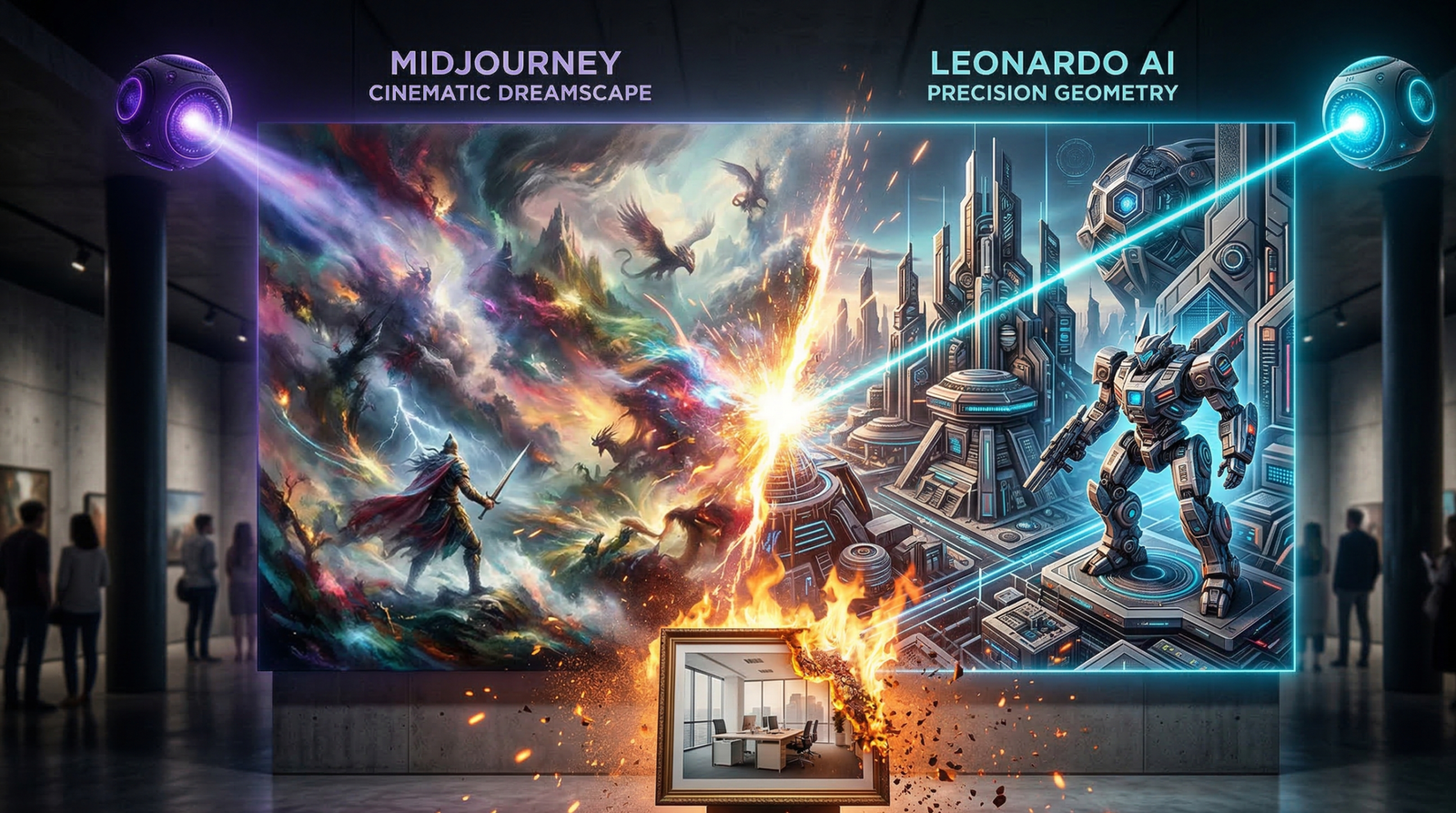
In 2026, the visual generation industry is a two-horse race. Artificial intelligence can now generate hyper-realistic photographs, cinematic 3D renders, and perfect vector graphics in a matter of seconds. But while there are dozens of image generators on the market, professionals consistently debate between two undisputed heavyweights: Midjourney and Leonardo.ai. They both promise to replace your need for stock photos, but their workflows, pricing, and artistic capabilities are drastically different. Before you lock yourself into a monthly subscription, here is the ultimate breakdown of which visual AI actually deserves your money.
Round 1: Artistic Quality and Photorealism
The most important question is: which AI generates the best-looking image?
- Midjourney: Since its inception, Midjourney has been the king of pure aesthetics. In 2026, its ability to generate hyper-realistic skin textures, cinematic lighting, and accurate human hands is unparalleled. It naturally defaults to a highly artistic, beautiful style even if your prompt is incredibly short.
- Leonardo.ai: Leonardo’s 2026 visual engine (Vision/Phoenix) is incredibly powerful, but it requires much more specific prompting to achieve the cinematic quality that Midjourney delivers by default. However, Leonardo is much better at strictly adhering to your prompt. If you ask for five specific objects in a room, Leonardo will place them perfectly, whereas Midjourney might ignore one to make the image look “prettier.”
Winner: Midjourney wins for pure, breathtaking artistic quality and photorealism. (Note: Visuals are only half the battle. If you want to know which AI models write the best scripts to accompany these images, check out our [Ultimate GPT-5.4 vs. Claude 4.6 Breakdown here].)
Round 2: Workflow and User Interface
How you interact with the software is just as important as the output it creates.
- Midjourney: For a long time, Midjourney forced users to generate images through Discord, which was chaotic and confusing for business professionals. While they now have a dedicated web interface for advanced users, the workflow still feels more like typing code into a terminal than using a design software. It is powerful, but not intuitive.
- Leonardo.ai: This is where Leonardo completely dominates. It is built entirely as a web application that feels like a modern version of Photoshop. It offers a “Real-time Canvas” where you can sketch rough shapes and watch the AI turn them into masterpieces instantly. It has sliders for lighting, built-in upscalers, and seamless background removal.
Winner: Leonardo.ai takes this round easily. It is an actual workstation, not just a prompt box.
Round 3: Pricing and Free Tiers
If you are running a lean business or a side hustle, monthly subscriptions add up quickly.
- Midjourney: There is no free tier. If you want to use Midjourney, you must pay their standard monthly subscription. Furthermore, if you want your images to be completely private (so other users can’t see your prompts), you have to pay for their ultra-premium “Pro” tier.
- Leonardo.ai: Leonardo remains the hero of the budget-conscious creator. They offer a highly generous daily token system. You can generate 15 to 20 high-quality images every single day completely for free, and yes, you are allowed to use those images commercially.
Start For Free: Leonardo isn’t the only premium tool offering an incredible free tier. Discover how to build a complete zero-cost workflow in our [2026 Guide to the Best FREE AI Tools].
The Secret Weapon: Image-to-Video Integration
Still images are great for blog posts, but social media is driven by video. Leonardo.ai features a built-in “Motion” button. Once you generate a beautiful image, you can click one button and the AI will add cinematic motion to it (like water flowing, clouds moving, or a character turning their head). Midjourney requires you to export your image and use a completely separate, third-party video tool to animate it.
Animate Your Art: If you want to take your static AI images and turn them into broadcast-quality commercials, you need the right video models. Read our ranking of the [Top 5 AI Tools for Video Creators and Marketers].
The Final Verdict: Which One Should You Choose?
The AI visual wars have split the market into two distinct groups.
Choose Leonardo.ai if: You are a marketer, blogger, game developer, or a YouTube creator running a [Faceless YouTube Channel]. If you need a complete digital canvas, absolute control over the placement of elements, built-in animation, and a generous free tier, Leonardo is the ultimate all-in-one visual studio.
Choose Midjourney if: You are an art director, concept artist, or professional designer who needs the absolute highest quality, museum-grade aesthetics, and cinematic lighting, and you don’t mind paying a monthly fee to get it.
Written By ToolChamber Editorial Team.